The Driving Test

Introduction
You have now completed the programme and should have the necessary driving skills to pass the UK driving test. However, before you take the test it’s important that you understand how the test works so that you do not get any surprises on the day. To do this your instructor will simulate a full driving test and act like an examiner. Therefore the purpose of this driving lesson is to make you comfortable with the driving test itself and identify any final driving weaknesses you may have.
The Driver and Vehicle Standards Agency driving test for car drivers is about 40 minutes long. During this time the examiner will expect you to satisfy the eyesight test, show and tell him how to undertake certain vehicle safety checks and demonstrate an ability to drive the car safely around a given test route. The route will encompass a wide variety of different road conditions and at various points along the way the examiner will also require you to complete certain test manoeuvres. In particular you will be required to undertake one of the following set manoeuvres and optionally the emergency stop:
Reverse parking behind a parked car or into a parking bay;
reversing round a corner to either the left or right;
turn in the road.
Driving on the test is a little different from driving with your driving instructor on a driving lesson. The most obvious difference is that the examiner is not going to help you with your driving or your answers to the “show me tell me” part of the test. However, the examiner will be happy to clarify any instruction they may have given to you. The examiner will also try to put you at ease, as the last thing that they want is to make you feel unnecessarily anxious. The examiner wants to test your driving ability not your nerve.
Therefore don’t be surprised at how friendly they are. You may find that your examiner offers encouragement or advice in regard to your test nerves. Once the examiner has introduced themselves, they will ask you to read a number plate at the required distance. Assuming that you are able to do this, the examiner will ask you to show the way to your vehicle where they will check its condition before entering the vehicle. At this point the examiner will ask you two questions, one ‘show me’ and one ‘tell me’. One or both questions answered incorrectly will result in one minor driving fault being recorded. If the “show me” question requires you to open the bonnet this question will be asked before you get into the vehicle otherwise the “show me tell me” part of the test will commence after you have entered the vehicle.
You will then start the driving part of the driving test. While still in the car park the examiner may ask you to pull forward and complete the bay park exercise or drive out straight onto the road. The examiner will tell you in good time which way to go. If you go the wrong way do not panic the examiner is testing your ability to drive not your ability to follow directions. It is better to go the wrong way correctly than to go the right way incorrectly. If at any time you are unsure what the examiner requires do not hesitate to check what they want; the examiner appreciates that you may be nervous and will be happy to repeat or clarify any instructions given. At certain points on the route the examiner may ask you to complete a set manoeuvre.
As soon you are asked to move off the examiner will start to assess your driving ability, noting any driving faults you may commit on the Driving Test Report – the DL25. There are three types of fault that you can commit – minor, serious or dangerous. A serious or a dangerous fault will result in a test failure. An accumulation of more than 15 minor driving faults will also result in a test failure.
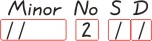 If a minor fault is committed the examiner denotes this by a ‘/’ slash in the first box against the appropriate report heading. At the end of the test the examiner will use the second box to denote the total number of minor driving faults against that heading. If a serious fault is committed the examiner will denote this by placing a ‘/’ in the third box against the appropriate heading. Finally, if a dangerous fault is committed the examiner will denote this by placing a ‘/’ in the fourth box against the appropriate heading.
A dangerous fault results in test failure because the examiner or another road user had been forced to take evasive action to avoid an accident.
A serious fault results in test failure because the fault affected another road user or had the potential to affect another road user.
A minor fault does not result in a test failure because it would not normally cause an accident but could be a contributing factor in certain circumstances. Fifteen or more such faults would suggest that the candidate was lucky not to have committed a serious or dangerous fault and should therefore fail the test.